
 영어
영어 프랑스
프랑스 스페인
스페인 러시아
러시아 한국
한국 일본
일본


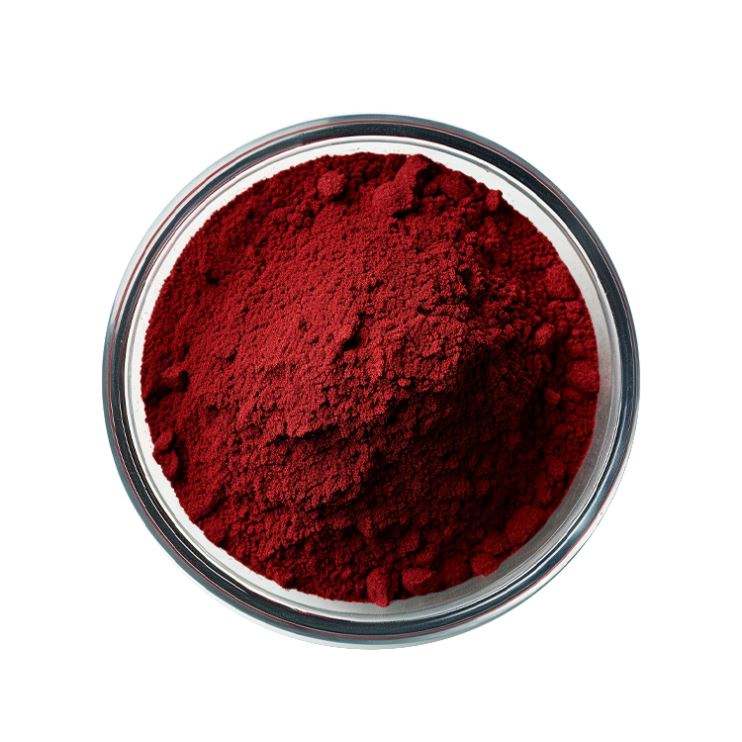
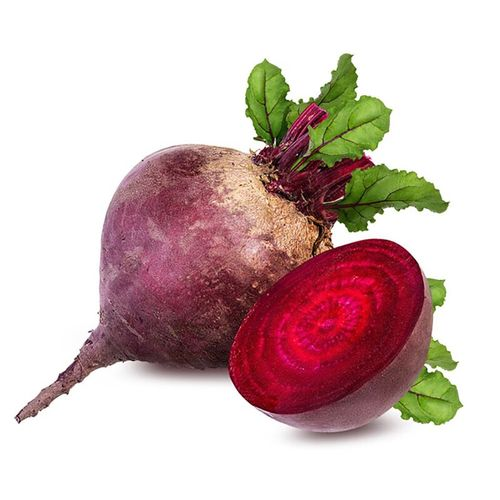
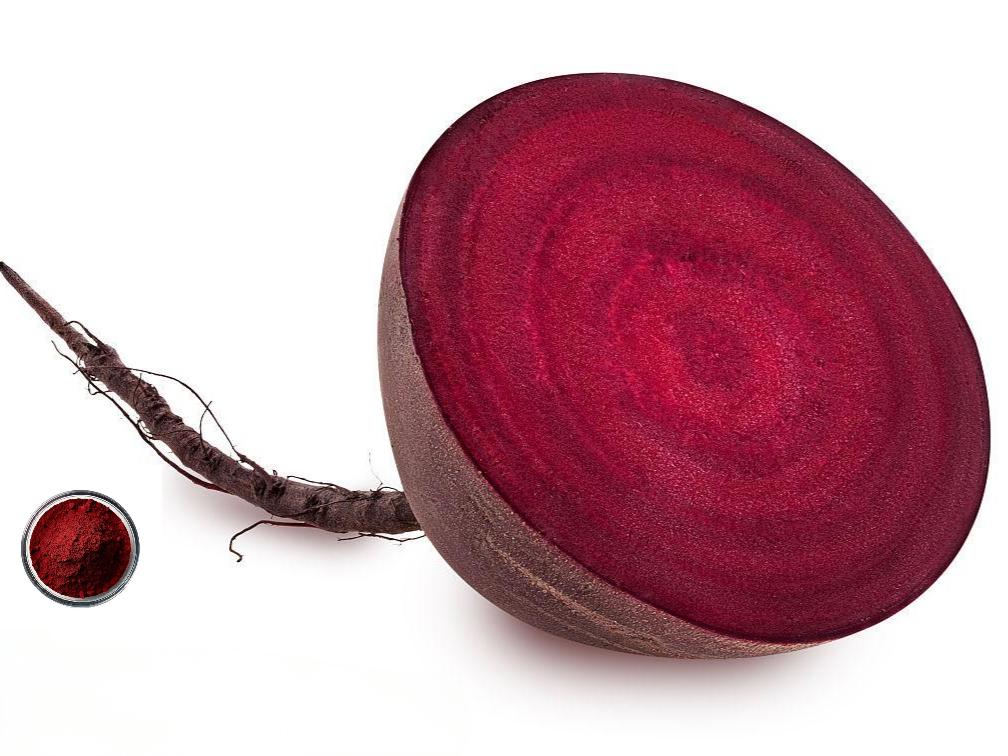
Granulated Beetroot Red E162 (Color Value E≥10)
ColorValue: (E1%1cm, 535nm, pH 3.0) ≥ 10.0
Latin Name: Beta vulgaris L.
Source: Beetroot (Root of Beta vulgaris)
pH Stability Range: 3.0 –7.0
Particle Size: ≥ 92% passing 40 - 80 mesh
Bulk Density: 0.52 g/mL - 0.68 g/mL
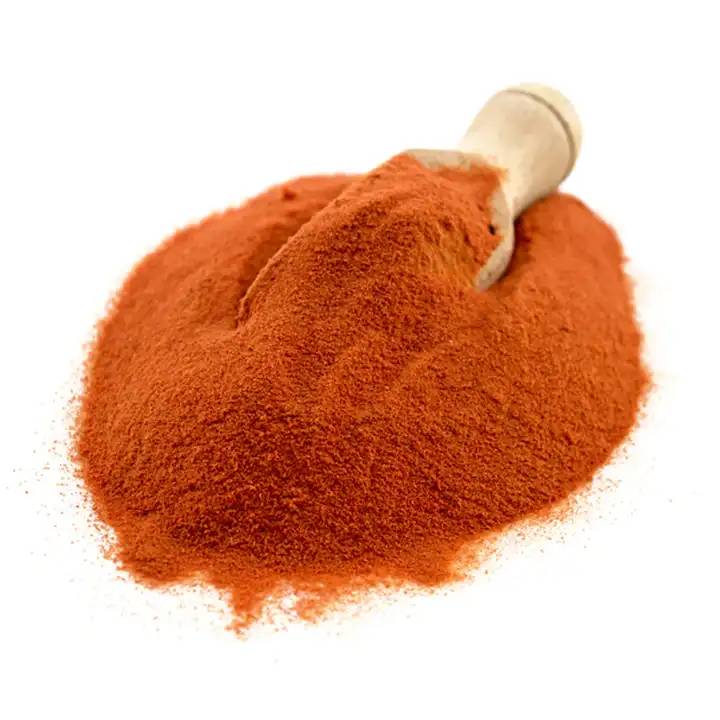
외모: Red to dark red free-flowing granules
Certificates: BRCGS, IFS, Organic (USDA/EU), Kosher, Halal
Sample: 10g-50g Free Sample Available for R&D
- 설명
- 데이터 시트
-
What is Granulated Beetroot Red E162?
Granulated Beetroot Red E162 is a plant-derived solid colorant from the roots of Beta vulgaris L다., with active betalains standardized to 1.0% Betanin via HPLC. Forminated into dust-free 40–80 mesh granules, the material maintains a verified Color Value (E1% 1cm at 535nm, pH 3.0) of Min. 10.0. 이purity profile complies strictly with EU Commission Regulation No 231/2012그리고US 21 CFR 73.40 regulatory standards.
Green Spring 기술 processes this ingredient via 100% water extraction, ensuring zero chemical solvent residues and a Loss on Drying (LOD) of ≤ 4.5%. Total ash is controlled at ≤ 5.0% and heavy metals at ≤ 10 ppm via ICP-MS, keeping batch-to-batch analytical deviation under 3.0%. The manufacturing infrastructure operates under audited BRCGS, IFS, ISO22000, Kosher, and Halal compliance quality systems.
The 0.52–0.68 g/mL bulk density and an angle of repose under 32 degrees eliminate particle segregation during dry blending. By lifting the critical relative humidity threshold, the granules resist moisture adsorption at up to 60% Relative Humidity (RH). This morphology prevents hopper bridging, ratholing, and tooling stickiness, optimizing fill-weight tolerances on automated capsule encapsulation lines and high-speed rotary tablet presses.
규격
제품 이름
Granulated Beetroot Red E162
라틴어 이름
Beta vulgaris L.
원본
Beetroot (Root of Beta vulgaris)
Color Value
(E1% 1cm, 535nm, pH 3.0);10.0 Min. via UV-Vis Spectrophotometry
활성 성분 Betanin 1.0% via HPLC Determination pH Stability Range 3.0 - 7.0 via pH Meter Verification 외모
Red to dark red free-flowing granules
Particle Size Minimum 92% passing 40 - 80 mesh via Analytical Sieve Method Angle of Repose < 32 Degrees via Gauge Flow Method Bulk Density 0.52 g/mL - 0.68 g/mL via USP <616> Method I Tapped Density 0.65 g/mL - 0.80 g/mL via USP <616> Method I Loss on Drying (LOD) <= 4.5% via Vacuum Oven (70C, 4 hours) Total Ash <= 5.0% via USP <281> Ashing Method Nitrate Content (as NO3) Meets EU standard limits via Ion Chromatography Heavy Metals (ICP-MS) Pb <= 2.0 ppm, As <= 1.0 ppm, Cd <= 1.0 ppm, Hg <= 0.1 ppm [Compliant with EU 231/2012 Purity Criteria] Microbiological Security TAMC <= 1,000 cfu/g, TYMC <= 100 cfu/g, Salmonella Absent/25g, E. coli Absent/10g [Compliant with USP <61> & <62>] 농약 잔류 물을 Complies with (EC) No 396/2005 via GC-MS/MS & LC-MS/MS 견적을 찾고 계십니까?우리에게 연락Request a Custom QuoteQuality & Compliance
Active Chromophore Standardization: Standardized to ~1.0% Betanin via HPLC, maintaining a verified Color Value (E1% 1cm at 535nm, pH 3.0) of ≥ 10.0 to eliminate batch-to-batch tinctorial variation.
Heavy Metals Limitation Framework: Total heavy metals are restricted to ≤ 10.0 ppm, capping individual limits at Lead (Pb) ≤ 2.0 ppm and Arsenic (As) ≤ 1.0 ppm via ICP-MS, strictly aligning with EU Commission Regulation No 231/2012 specifications for E162.
Pesticide Residue Control: Agricultural raw materials undergo multi-residue screening via GC-MS/MS and LC-MS/MS, ensuring comprehensive compliance with European food safety limits defined under Regulation (EC) No 396/2005.
Global Regulatory Certifications: Extraction infrastructure holds current BRCGS (Grade A), IFS (Higher Level), ISO9001, and ISO22000 quality management approvals, with active batch-specific validation for EU Organic, USDA Organic, Kosher, and Halal standards.
Manufacturing Traceability Matrix: Process controls maintain a strict batch-to-batch analytical deviation under 3.0% and an absolute Loss on Drying (LOD) of ≤ 4.5%, supported by registered FDA facility identification and COSMOS validation.
Documentation Stream & Validation: Every physical shipment is dispatched with an original Certificate of Analysis (CoA), Technical Datasheet (TDS), and Material Safety Datasheet (MSDS), with independent third-party verification through SGS or Eurofins accessible upon request.

Key Advantages
High-Flowability Geometry: Fluid-bed top-spray agglomeration re-engineers irregular particles into uniform granules, yielding an angle of repose under 32 degrees and a Hausner Ratio below 1.18. This geometry ensures predictable gravity-fed flow, eliminating hopper bridging, material ratholing, and pneumatic archiving in automated dry powder pipelines.
Moisture Adsorption Defense: Agglomeration minimizes specific surface area, lifting the critical relative humidity threshold of the natural beet sugars. The granules resist surface melting and caking at up to 60% Relative Humidity (RH), preventing material clumping and equipment clogging during fluctuating facility conditions.
Anti-Segregation Density Matching: The controlled 0.52–0.68 g/mL bulk density aligns with standard solid dosage excipients like microcrystalline cellulose (MCC). This density parity prevents gravity-induced particle segregation during blending, ensuring uniform tinctorial and active distribution throughout the discharge cycle.
Anti-Sticking Tooling Compatibility: Replacing cohesive fine powders with robust 40–80 mesh granules improves clean-shearing under compression. This physical modification mitigates punch-face picking, die-cavity sticking, and tablet capping defects, minimizing unscheduled line shutdowns for machinery maintenance.
Zero-Dust Contamination Mitigation: The elimination of ultra-fine dusting fractions prevents airborne pigment dispersion within multi-ingredient blending cleanrooms. This mechanical containment controls the risk of cross-contamination, reducing facility sanitization downtime between commercial batch changes.
Applications
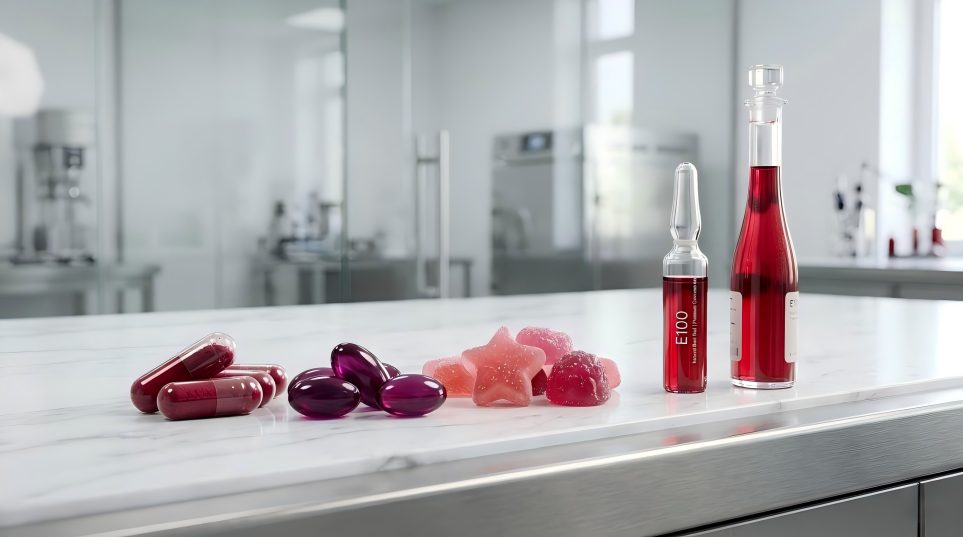
Nutraceutical Hard Capsules and Tablets: The 40–80 mesh granulated raw material is engineered for direct loading into high-speed automatic encapsulation machinery. Maintaining a consistent bulk density matching microcrystalline cellulose excipients, the granules secure rapid die-cavity filling without mechanical bridging or tamping pin sticking. This physical alignment ensures mass uniformity across automated capsule encapsulation lines and rotary tablet presses, making the ingredient suitable for clean-label botanical formulations.
Direct Compression Solid Dosage Formulations: Formulated for manufacturing lines requiring precise dye loading under automated direct compression tableting. The high structural integrity of the granulated beet red resists fragmentation during bulk dry blending, preventing gravity-induced particle segregation. This structural defense limits the frequency of tooling defects such as tablet capping, laminate cracking, or punch-face picking under standard compression forces.
Functional Food Dry Mixes and Stick Packs: Applied as a natural red food colorant in functional protein drink powders, collagen drink mixes, and meal replacement sachets requiring visual color uniformity in dry blend form. The controlled particle size distribution prevents the organic color granules from settling to the bottom of industrial blending hoppers during discharge, maintaining homogeneous pigment distribution within commercial single-serve pouches and individual stick packs.
Low-Moisture Functional Confectionery and Chewable Chew Matrices: Utilized in low-temperature compressed chewable tablets, vitamin tablet wafers, and moisture-controlled solid matrices where water activity is minimized to protect heat-sensitive betalains. The granulated format disperses uniformly within dry granulates, providing a stable, fading-resistant red shade throughout the commercial shelf life without introducing excessive anti-caking chemical glidants or processing lubricants into the production system.
Technical FAQ
Q1: How does the mesh profile of Fluid Bed Granulated Beet Red E162 resolve hopper bridging on automated packing lines?
A: Standard spray-dried beetroot powders feature ultra-fine, irregular geometries that drive electrostatic agglomeration and material bridging within filling hoppers. Fluid-bed top-spray processing re-engineers these cohesive particles into uniform micro-granules with ≥ 92% passing a 40–80 mesh sieve, reducing the angle of repose to < 32° and the Hausner Ratio to < 1.18. On high-speed packing systems, this enhanced fluidity ensures a predictable gravity-fed flow rate, eliminating pneumatic archiving and mechanical blockages during large-scale manufacturing.
Q2: What shop-floor stability advantages do Non-Caking Beetroot Red Granules offer over conventional powders during humidity fluctuations?
A: The low-molecular-weight sugars in raw beet extracts possess a low glass transition temperature, causing conventional fine powders to adsorb moisture rapidly and form cake aggregates. Agglomerated granules significantly minimize exposed specific surface area, raising the critical relative humidity threshold. At up to 60% Relative Humidity (RH), the granular matrix resists surface condensation and moisture absorption, preventing tooling stickiness, die-cavity binding, and punch-face picking on rotary tablet presses to reduce unscheduled machinery maintenance down-time.
Q3: What dry blending strategies prevent ingredient segregation when incorporating Standardized Betanin 1.0% Powder/granules into multi-nutrient matrixes?
A: Material segregation occurs when the size and density of the colorant deviate from primary excipients, causing the pigment to settle unevenly during discharge. This granular batch maintains a controlled bulk density of 0.52–0.68 g/mL, establishing tight spatial parity with standard carriers like microcrystalline cellulose (MCC). To secure quantitative color uniformity, processing engineers should execute a geometric dilution sequence during dry blending and optimize mixer tumbling frequency, ensuring an absolute batch-to-batch analytical deviation under 3.0%.
Why Partner With Green Spring Technology?
Custom Granulation Expertise: Processing controls deploy fluid-bed top-spray granulation to eliminate highly hygroscopic fine powders. The active betalain matrix is standardized to a verified Color Value of ≥ 10.0 and ~1.0% Betanin via HPLC, safeguarding pigment structural integrity against processing discoloration.
Audited Food Safety Infrastructure: Extraction facilities undergo continuous third-party hazard audits, maintaining active certifications under BRCGS (Grade A) and IFS (Higher Level) food safety standards. The manufacturing ecosystem integrates operating protocols fully aligned with ISO9001 and ISO22000 criteria.
Traceable Dual Organic Supply: Raw material procurement networks provide complete farm-to-shipment monitoring for specialized batches certified to EU Organic and USDA Organic standards. This traceable agricultural stream ensures incoming crops strictly meet low-nitrate limits and clear origin validation.
Cross-Sector Material Compliance: Automated production pipelines maintain COSMOS validation for natural cosmetics. This multi-sector certification matrix enables Green Spring Technology to supply uniform, non-toxic batches that seamlessly cross-enter functional food, nutraceutical, and natural beauty manufacturing lines.
Sample Protocol and Short Lead Times: Downstream formulation risk is minimized through a centralized sampling framework providing 10g–50g free samples with batch-specific CoAs. Supply chains maintain extensive safety stock to secure commercial lead times of 7–14 working days under stable contract pricing.
-
Download Data Sheet: COA, TDS, MSDS Please fill in the form below to receive the full technical documents via email.