
 영어
영어 프랑스
프랑스 스페인
스페인 러시아
러시아 한국
한국 일본
일본


Bulk Bromelain Powder 2400 GDU/g | Cold-Ultrafiltered
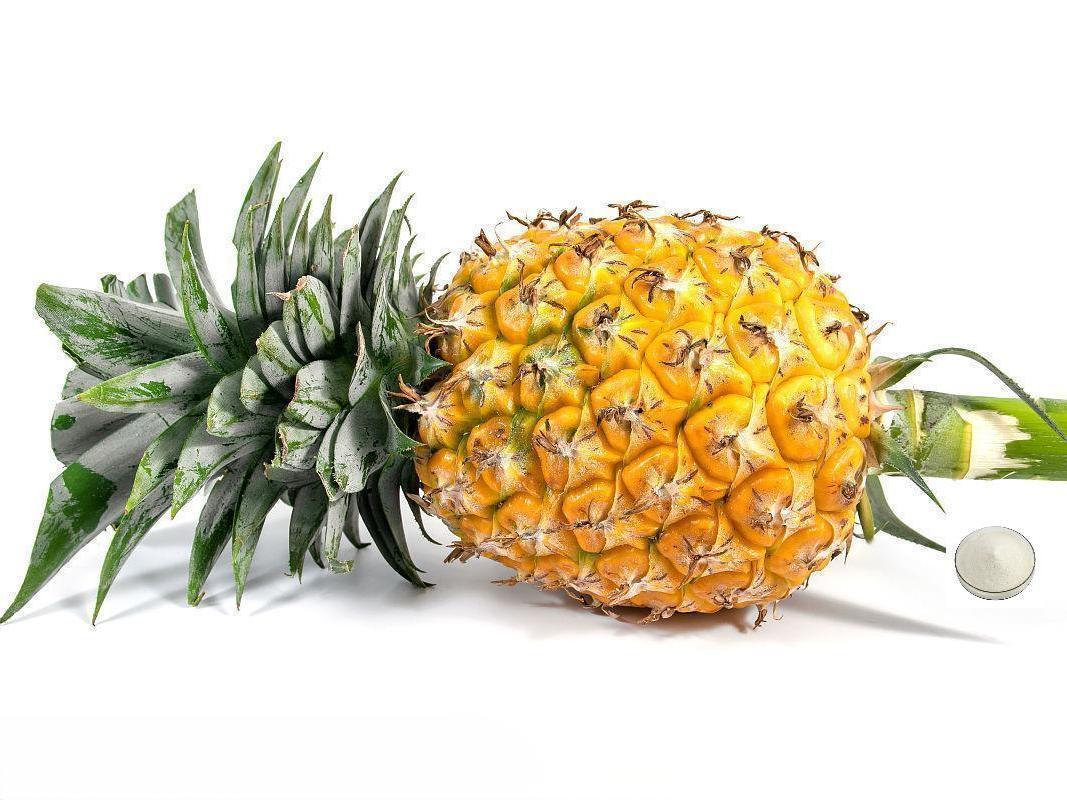
Latin Name: Ananas comosus (Linn.) Merr.
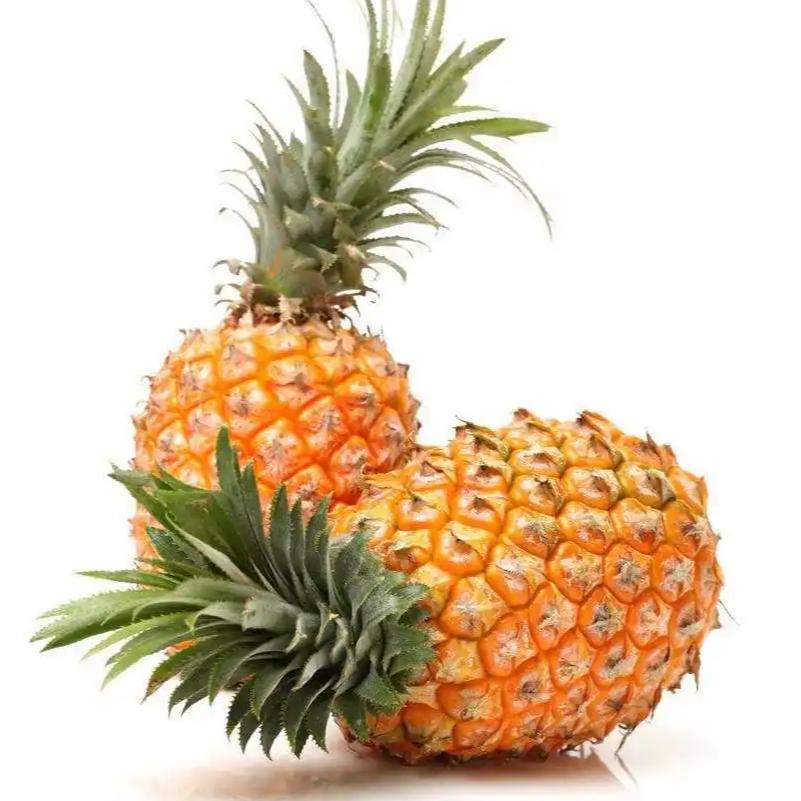
Source: Dried stem of Ananas comosus (100% species authenticated)
CAS No.: 9001-00-7
Enzyme Activity: ≥2,400 GDU/g (Cold-Ultrafiltered Specification)
Solution Clarity: Transmittance ≥95.0% (1% aqueous solution at 440nm)
Testing Method: USP / FCC Monograph Compliant
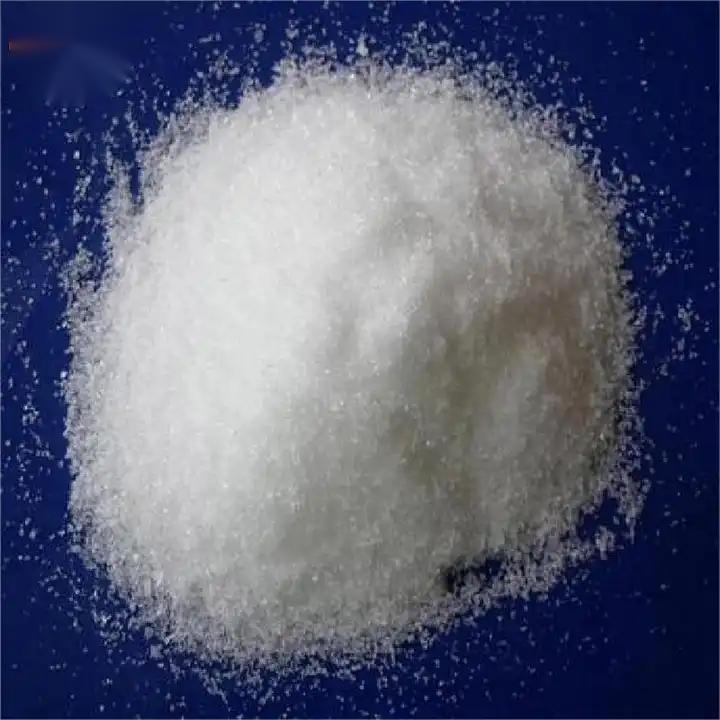
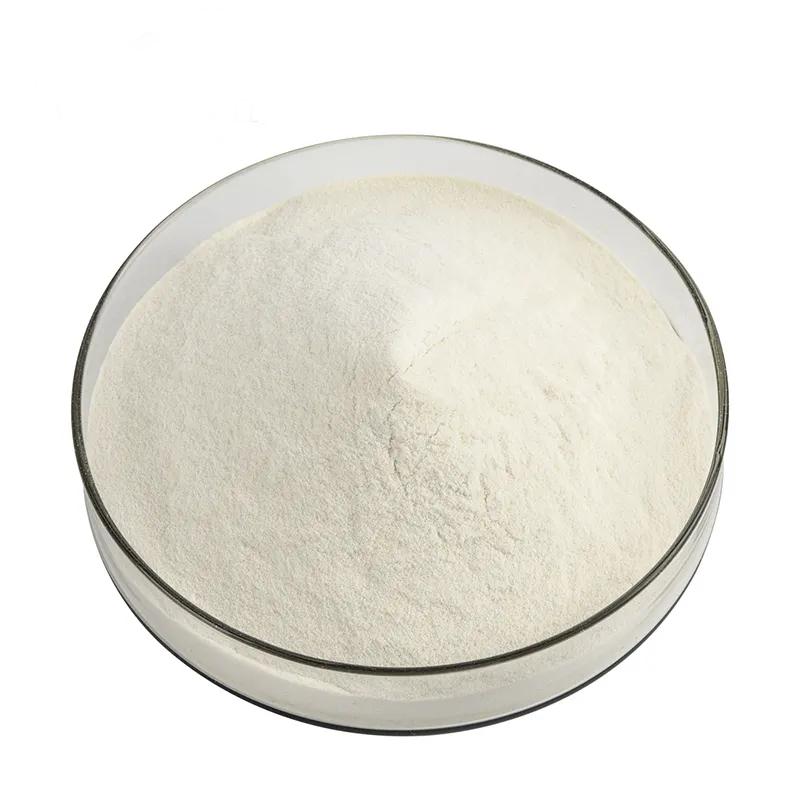
외관:밝은 노란색 미세 분말
Pesticide Residue:Comply with (EC) No 396/2005 표준입니다
Certificate: BRCGS, IFS, Organic (USDA/EU), Halal, Kosher
Sample: 10-50g Free Sample Available for R&D
- 설명
- 데이터 시트
-
What is 브로 멜 라인 파우더 2400 GDU/g?
Bromelain Powder 2400 GDU/g is a standardized proteolytic enzyme complex isolated from the stems of Ananas comosus다. Standardized to a biological activity profile of ≥2,400 GDU/g (Gelatin Digesting Units) per USP/FCC official methods, this substance functions as a plant-derived endopeptidase, hydrolyzing peptide bonds within diverse manufacturing parameters.
Production of this commercial-scale grade utilizes a non-thermal, proprietary low-temperature membrane ultrafiltration process. This physical isolation sequence removes high-molecular-weight plant polysaccharides and insoluble botanical mucilage while retaining the enzyme's three-dimensional molecular architecture, preventing loss of active catalytic sites during fluid processing stages.
이Cold-Ultrafiltered 2400 GDU/g specification is engineered for liquid dosage stability and clarity, achieving a high transmittance profile in aqueous media without subsequent sedimentation or turbidity. This processing behavior minimizes the technical necessity for corrective synthetic clearing agents, supporting clear solution aesthetics and chemical uniformity in liquid functional beverages, clarifying cosmeceutical skincare serums, and aqueous wellness shots.
규격
제품 이름
Bromelain Powder
라틴어 이름
Ananas comosus (Linn.) Merr.
캐 스 가 없다.
9001-00-7
원본
Dried stem of Ananas comosus
Enzyme Activity
≥2,400 GDU/g
시험 방법
USP/FCC Monograph
외모
연한 노란색 가루
Processing Method Water-based cross-flow membrane ultrafiltration at 4°C – 8°C [Non-thermal Physical Isolation] Transmittance (Clarity) ≥95.0% in 1% aqueous solution at 440nm [Spectrophotometry for liquid dosage stability] Solubility & Dispersion Soluble in water (Forms a clear, sediment-free solution via Gravimetric Analysis) Particle Size 95% through 80 mesh Loss on Drying (LOD) ≤5.0% Solvent Status Solvent-free (Produced without acetone, ethanol, or chemical precipitants) Heavy Metals Pb ≤1.0 ppm, As ≤0.5 ppm, Cd ≤0.1 ppm, Hg ≤0.1 ppm [ICP-MS via USP <233> / EP 2.4.20] Pesticide Residues Complies with European Regulation (EC) No 396/2005 Standard [GC-MS / LC-MS-MS] Microbiological Security Total Plate Count ≤10,000 cfu/g; Yeast & Mold ≤100 cfu/g; Salmonella & E. coli: Absent per 10g 견적을 찾고 계십니까?우리에게 연락Request a Custom QuoteQuality & Compliance
Manufacturing & Quality Standards
Production processes operate in compliance with US FDA registration, cGMP requirements, BRCGS Food Safety Standard, and IFS Food certification to ensure batch-to-batch consistency under global GFSI-benchmarked manufacturing protocols.Management Systems
Quality management and food safety hazard identification frameworks are structured and verified under certified ISO 9001:2015 and ISO 22000:2018 systems across the processing supply chain.Dietary & Regulatory Market Access
The Bulk Bromelain material carries official Halal and Kosher (Pareve) certifications, complies with EU Organic and USDA Organic regulations, and fulfills COSMOS criteria for clean cosmetic formulations.Enzymatic Potency Verification
Biological catalytic activity is evaluated via standardized gelatin digestion assays, conforming strictly to USP and Food Chemicals Codex (FCC) monographs to guarantee a standardized activity profile of 2,400 GDU/g.Elemental Impurities & Heavy Metals Control
Impurity thresholds are monitored via ICP-MS analysis aligned with USP <233> and EP 2.4.20, restricting individual limits to Lead (Pb) ≤1.0 ppm, Arsenic (As) ≤0.5 ppm, Cadmium (Cd) ≤0.1 ppm, and Mercury (Hg) ≤0.1 ppm for California Proposition 65 compliance.Pesticide Residue Limits
Pesticide screening profiles are documented via GC-MS and LC-MS-MS instrumentation, maintaining strict conformance with European Regulation (EC) No 396/2005 maximum residue limits (MRLs) and USP <561> parameters.Solvent Status & Regulatory Dossiers
Complete technical dossiers—including Certificates of Analysis (CoA), Solvent-Free Declarations (verifying the absence of acetone, ethanol, or chemical precipitants), ETO-Free Statements, Non-GMO Project Declarations, and BSE/TSE-Free Certificates—are maintained and accessible for regulatory auditing upon request.
Key Advantages
Enzymatic Architecture Retention
Operating under 40°C restricts thermal denaturation, supporting catalytic retention of active proteolytic sites. This cold-processing sequence secures continuous protein integrity during fluid manufacturing stages without introducing high-heat degradation typical of conventional spray-drying.Formulation Solution Clarity
The crystalline matrix achieves uniform dispersion in aqueous vehicles without generating colloidal haze or particle refraction distortion. This solubility behavior maintains long-term structural clarity and transperancy in functional beverages, clarifying skin serums, and multi-ingredient liquid nutraceutical formulations.Processing Consistency
Standardized particle size distribution locked at 95% through 80 mesh, paired with controlled moisture restrictions (LOD ≤5.0%), optimizes physical powder fluidity. This uniform granulometry mitigates caking, friction-induced heat, and electrostatic clinging, ensuring stable volumetric feeding through automated packing lines.Biochemical Environment Adaptation
The endopeptidase exhibits functional stability across comprehensive pH environments from 4.0 to 9.0. This chemical neutrality prevents active molecule precipitation or cleavage failure when compounding across diverse matrix ranges, spanning from low-acid functional foods to topical skin-barrier emulsions.Industrial Batch Yield Maximization
Controlled particulate fluidity prevents mechanical bridging and localized active ingredient separation during ribbon-blending workflows. This consistent rheological behavior reduces material wall-sticking losses and equipment friction attrition within industrial hoppers, maximizing final manufacturing batch yields.
Applications
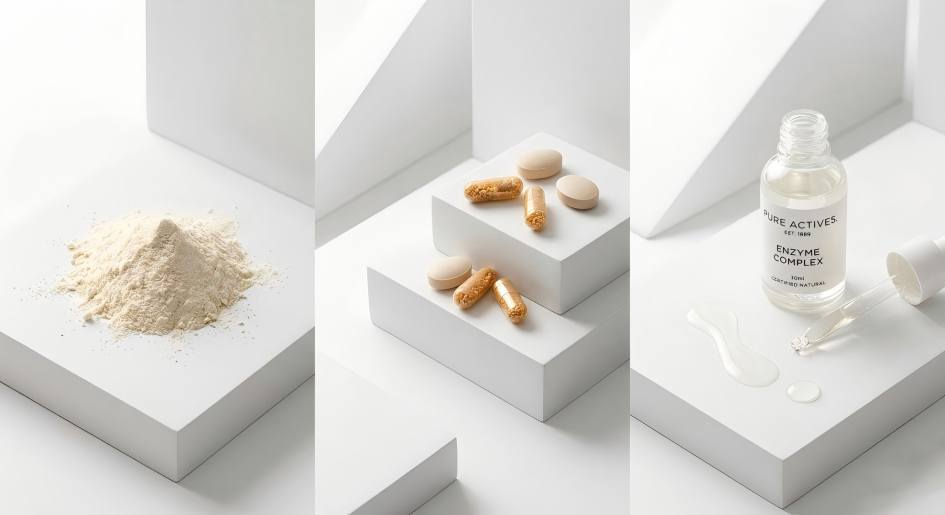
Liquid Nutraceuticals & Supplements
Engineered for aqueous systems, this grade serves as an active ingredient in functional sports drinks, liquid shots, and clear syrups. The material achieves rapid dispersion in water, establishing a transparent solution profile that maintains clarity over extended shelf-life cycles without inducing post-processing sedimentation, turbidity, or haze formation.Cosmeceuticals & Advanced Skincare
Utilized as a bio-based exfoliating agent in COSMOS-compliant cosmetic applications, including clarifying enzyme peel drops and transparent facial serums. The active molecule blends into water-based topical formulas without disrupting emulsion viscosity or inducing oil-water phase separation, while its low hygroscopicity resists ambient moisture to prevent clumping in dry powder cleansers.Pharmaceutical & Clinical Formulations
The standardized proteolytic kinetics of ≥2,400 GDU/g provide predictable peptide cleavage profiles for targeted enteric-coated tablets requiring specialized polymer films. In topical applications, this enzyme uniformity supports continuous stabilization for clinical-grade wound debridement ointments, enzymatic wound-cleansing matrices, and advanced hydrogel dressings.Industrial Food Processing
Functions as a clean-label processing aid in automated commercial bakeries to structurally modify gluten networks, regulating baking dough elasticity, sheetability, and crumb volume. The uniform granulometry also supports homogeneous dry-blending into industrial meat tenderizers and commercial seasoning matrices, ensuring consistent active distribution across large manufacturing batches.
Technical FAQ
Q1: How does the cold-ultrafiltration process enhance the specific activity and purity profile of this 2400 GDU/g Bromelain powder?
Processing utilizes cross-flow membrane separation at 4°C to 8°C (39°F to 46°F) to isolate active Ananas comosus proteases. This non-thermal physical concentration rejects high-molecular-weight non-functional proteins, plant pigments, and mucilage without heat or chemical precipitants. The resulting 2400 GDU/g matrix delivers high catalytic activity per milligram of protein, establishing long-term solution clarity and minimizing organic impurities compared to standard solvent-precipitated grades.
Q2: Cold-ultrafiltered enzyme powders are highly purified. How does this grade perform regarding autolysis (self-digestion) in aqueous formulations?
Purified protein fractions accelerate autolysis (enzyme self-digestion) when hydrated, causing active potency degradation. The 2400 GDU/g crystalline powder is stable in dry forms, but for liquid formulations or functional beverages, water activity (aw) must be managed below 0.85. Standard stabilization protocols involve compounding the enzyme alongside polyols, such as Glycerin or Sorbitol, or maintaining an acidic pH barrier of 4.5 to 5.0 to temporarily decelerate autolytic cleavage prior to consumption.
Q3: Does this cold-ultrafiltered Stem Bromelain Powder guarantee compliance with Clean Label and solvent-free regulatory frameworks in the EU and US?
The multi-stage cold-ultrafiltration is a water-based, mechanical isolation sequence executed completely solvent-free. Production operates with zero extraction solvents such as acetone or ethanol, fulfilling clean-label manufacturing and non-GMO requirements. Batch validation via HPLC and SDS-PAGE confirms that heavy metal thresholds conform to strict compendial limits, maintaining Lead (Pb) ≤1.0 ppm and Cadmium (Cd) ≤0.1 ppm for regulatory compliance in nutraceutical and cosmetic formulations.
Why Partner With Green Spring Technology?
26-Year Extraction Infrastructure
Established in 2000, Green Spring Technology delivers over a quarter-century of continuous phytogenic manufacturing expertise to secure international ingredient supply chains under validated tier-1 industrial standards.Global Compliance Certification
Production facilities operate under audited compliance frameworks, holding valid BRCGS, IFS Food, US FDA registration,ISO9001, and ISO22000 certifications. Standardized botanical materials conform to international regulatory boundaries, verified by official Halal, Kosher (Pareve), and COSMOS criteria.Non-Thermal Filtration Frameworks
The production line integrates specialized, low-temperature membrane filtration infrastructure operating under 40°C fluid parameters. This physical separation sequence prevents thermal denaturation, securing an enhanced active proteolytic enzyme retention rate compared to conventional spray-drying.50+ Metric Tons Annual Capacity
Vertically integrated agricultural cultivation bases guarantee continuous access to raw pineapple stems year-round. This structured upstream procurement stabilizes volume availability and delivery lead times, mitigating market-driven seasonal shortages or factory production downtime.Multi-Elemental Analytical Verification
Every contract volume undergoes batch-specific qualification via advanced HPLC and ICP-MS instrumentation. Quality control parameters rigorously enforce pharmacopeial purity thresholds, maintaining Lead (Pb) ≤1.0 ppm, Arsenic (As) ≤0.5 ppm, Cadmium (Cd) ≤0.1 ppm, and Mercury (Hg) ≤0.1 ppm for absolute regulatory clearance.
-
Download Data Sheet: COA, TDS, MSDS Please fill in the form below to receive the full technical documents via email.