
 영어
영어 프랑스
프랑스 스페인
스페인 러시아
러시아 한국
한국 일본
일본


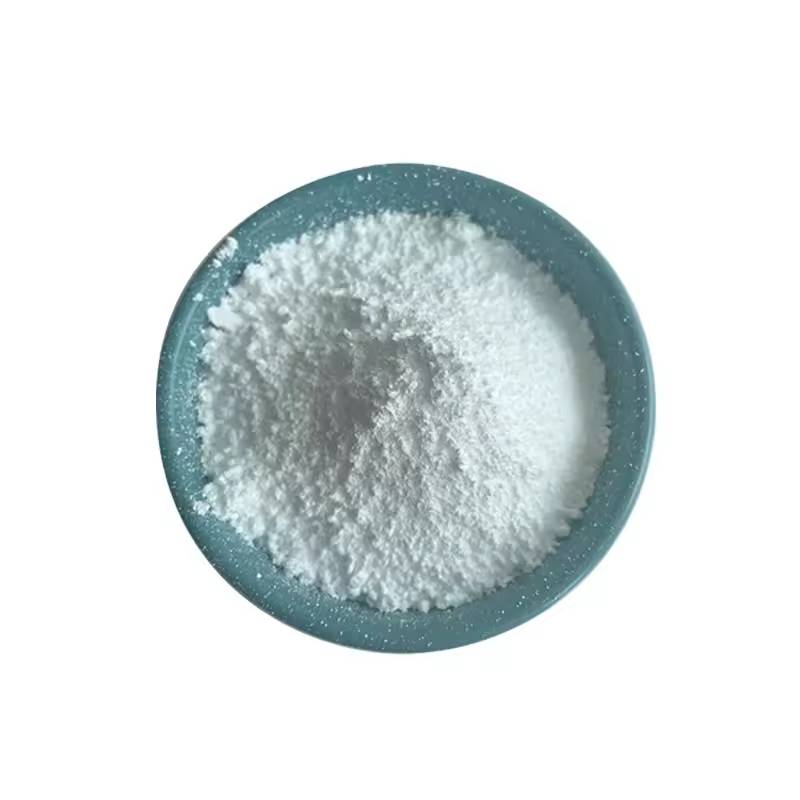
Direct Compression Stevia Granules
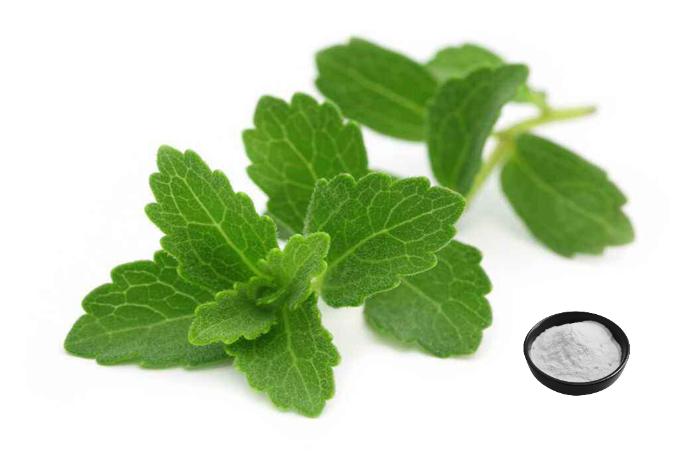
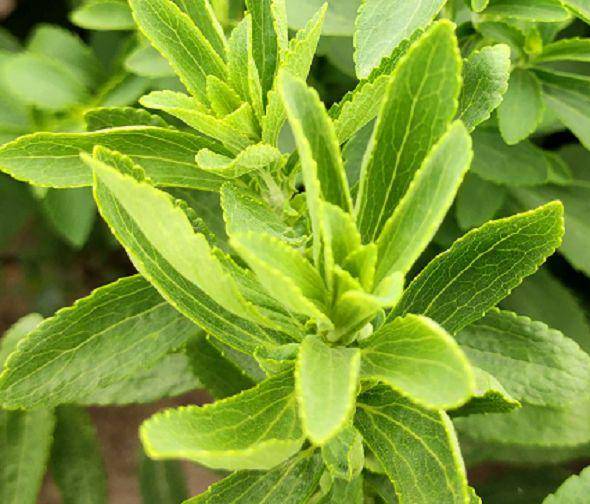
Source: Stevia rebaudiana Bertoni (L.) leaf
Assay: Total Steviol Glycosides (TSG) ≥ 95.0% (On Dry Basis)
시험 방법:HPLC
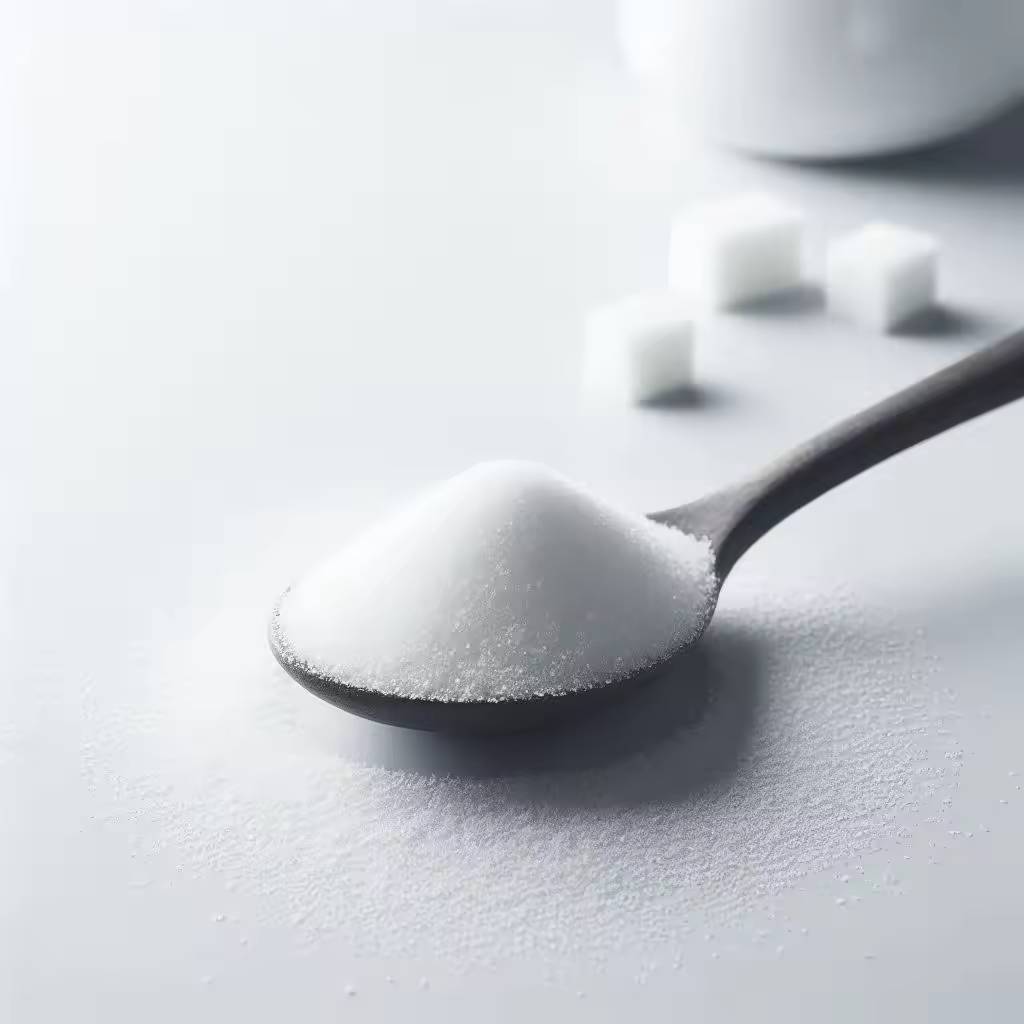
Appearance: White Free-Flowing Granules
Particle Size: 20–60 mesh
Bulk Density: 0.55- 0.70 g/mL
Tapped Density: 0.65-0.85 g/mL
Angle of Repose: < 35°
Loss on Drying: ≤ 4.0%
Certificate: BRCGS, IFS, Organic (USDA/EU), Halal, Kosher
Sample: 10-50g Free Sample Available for R&D
- 설명
- 데이터 시트
-
Whatis Direct Compression Stevia Granules?
Direct Compression Stevia Granules represent a physically modified, agglomerated high-intensity sweetener engineered for solid dosage manufacturing from Stevia rebaudiana Bertoni (L.) leaves. Standardized via HPLC to match industrial sweetness profiles, this white granular matrix delivers a clean sweetening potency approximately 200 to 300 times that of sucrose without undergoing structural decomposition during downstream compression.
The structural matrix is processed via fluid-bed granulation to aggregate fine botanical isolates into a standardized particle distribution calibrated strictly between 20 to 60 mesh. This physical architecture optimizes the bulk density framework to a stable range of 0.55 g/mL to 0.70 g/mL, enhancing gravitational mass flow coefficients and eliminating the high electrostatic surface charge typical of standard fine extract powders.
The mechanical design secures an angle of repose under 35 degrees to address high-speed tableting and hard-gelatin encapsulation line vulnerabilities. Green Spring Technology regulates production parameters to lock initial moisture at ≤ 4.0% Loss on Drying paired with a Water Activity (Aw) <= 0.25, successfully neutralizing intermolecular hydrogen bonding to eliminate feed hopper bridging, mass-stratification, and punch-face die-sticking.
규격
제품 이름
Direct Compression Stevia Granules
라틴어 이름
Stevia rebaudiana Bertoni (L.)
원본 Stevia rebaudiana Bertoni (L.) leaf
프로세스 Fluid-Bed Granulation & Crystalline Matrix Aggregration (100% Carrier-Free) 검사
Total Steviol Glycosides (TSG) ≥ 95.0% (On Dry Basis)
시험 방법
High-Performance Liquid Chromatography (HPLC)
외모
White Free-Flowing Granules
Odor & Taste Characteristic Intense Sweetness, Clean Profile, Zero Metallic Aftertaste Particle Size 20–60 mesh Bulk Density 0.55 g/mL to 0.70 g/mL Tapped Density 0.65 g/mL to 0.85 g/mL Angle of Repose < 35° (Calibrated for gravitational mass flow optimization) Loss on Drying ≤ 4.0% Water Activity (Aw) ≤ 0.25 (Calibrated for hygroscopic caking and agglomeration mitigation) Friability Matrix Complies with industrial high-shear mechanical dry-blending parameters Heavy Metals (ICP-MS) Pb ≤ 0.5 ppm, As ≤ 0.5 ppm, Cd ≤ 0.1 ppm, Hg ≤ 0.03 ppm [Complies with USP <2232>] Residual Solvents (GC-HS) Ethanol ≤ 5,000 ppm, Methanol ≤ 200 ppm [Complies with ICH Q3C Class 3] Pesticide Residues Complies with (EC) No 396/2005 & USP <561> via GC-MS/MS & LC-MS/MS Microbiological Security TAMC ≤ 1,000 cfu/g, TYMC ≤ 100 cfu/g, Salmonella: Absent/25g, E. coli: Absent/10g [USP <61> & <62>] 견적을 찾고 계십니까?우리에게 연락Request a Custom QuoteQuality & Compliance
Engineering Validation: Fluid-bed mechanics guarantee particle stability tightly within the 20–60 mesh distribution. This strict granulometric control ensures seamless compliance across high-speed tablet machinery, preventing tooling wear or fine micro-powder emissions.
Lot Reproducibility: Automation controls calibrate volumetric bulk density within a rigorous 0.55 to 0.70 g/mL envelope. Every batch is certified for granular strength, guaranteeing zero segregation or weight variance at high packaging frequencies.
Moisture Immobilization: Protocols enforce a moisture limit of ≤ 4.0% Loss on Drying paired with a Water Activity (Aw) <= 0.25 threshold. This dual barrier eliminates hydrogen bonding, defending against hygroscopic caking or feed hopper bridging.
Clean-Label Identity: Supply chain tracing verifies 100% carrier-free compliance without maltodextrin or synthetic flow agents. The matrix carries valid EU Organic, USDA Organic, and COSMOS registrations alongside transnational Halal and Kosher credentials.
Audit Infrastructure: Green Spring Technology operates under validated BRCGS (Grade A), IFS (Higher Level), ISO9001, and ISO22000 matrices under FDA Facility Registration. Rapid Technical Dossier dispatch verifies compliance with USP <2232> heavy metals (Pb <= 0.5 ppm, As <= 0.5 ppm, Cd <= 0.1 ppm, Hg <= 0.03 ppm), USP <61> & <62> microbes, USP <561> pesticides, and ICH Q3C Class 3 solvents (Ethanol <= 5,000 ppm, Methanol <= 200 ppm).

Key Advantages
Excipient Compatibility Matrix: The 100% carrier-free granulated matrix exhibits complete chemical neutrality when dry-blended with polyols, soluble dietary fibers, or microcrystalline cellulose. This structural passivity prevents dynamic ingredient cross-interactions, browning reactions, or phase separation within solid dosage matrices and localized compound dry blends.
Mass Flow & Mechanical Flowability: Engineered with a strict particle size distribution calibrated between 20 and 60 mesh and a bulk density of 0.55 g/mL to 0.70 g/mL, the granules achieve an angle of repose under 35°. This optimal fluid-bed geometry facilitates a consistent gravitational mass flow coefficient, accelerating feed hopper discharge on automated tableting machinery.
Moisture and Tooling Protection: Restricting moisture limits to ≤ 4.0% Loss on Drying paired with a strict Water Activity (Aw) <= 0.25 threshold immobilizes intermolecular hydrogen bonding under high packaging frequencies. This precise powder dynamic eliminates particle-to-particle moisture migration, preventing hopper bridging and automatic punch-face die-sticking.
Uniformity Strategy & Anti-Segregation: The calculated tapped-to-bulk density ratio maximizes matrix blending homogeneity during high-shear industrial dry processing. By eliminating fine micro-powder under 80 mesh, the structural layout prevents dynamic mass-stratification, enabling formulators to secure absolute weight variance control across high-speed encapsulation lines.
Applications
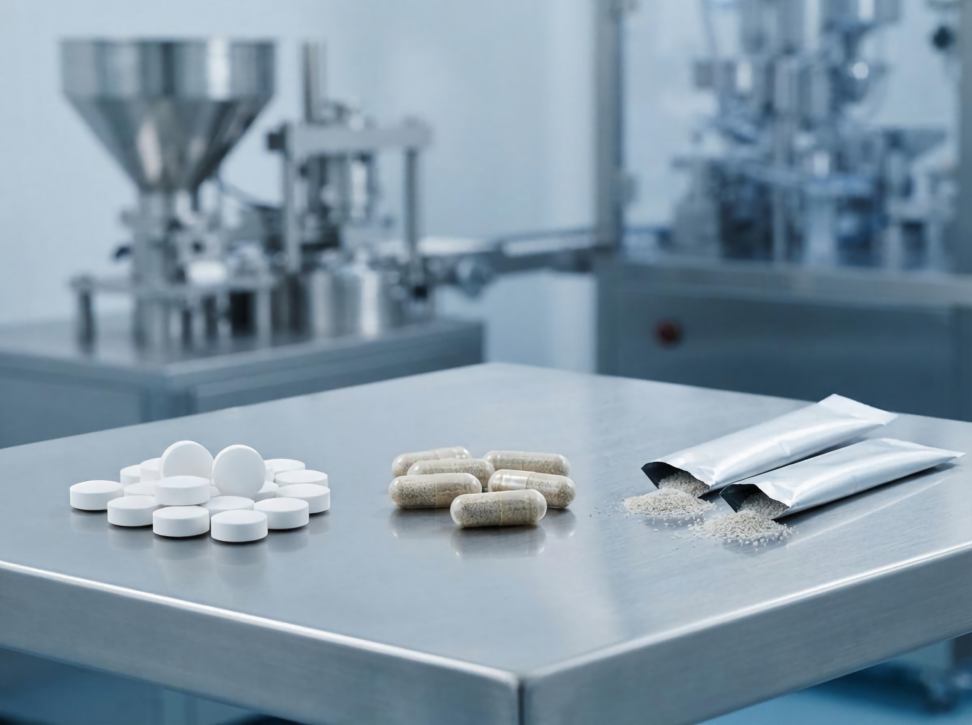
Dietary Supplement Tableting & Direct Compression (DC) Machine Lines
The granular matrix exhibits optimal compressibility within high-speed rotating tableting lines without requiring external synthetic binders. Engineered with a stable mesh footprint of 20–60 mesh and a bulk density of 0.55 to 0.70 g/mL, the ingredient supports uniform volumetric flow across high-frequency packaging operations. Locking the Water Activity (Aw) <= 0.25 and moisture to ≤ 4.0% Loss on Drying neutralizes dynamic friction and electrostatic charge, preventing punch-face die-sticking or tablet capping on automation machinery.Automated Hard-Gelatin Encapsulation & Volumetric Filling Loops
The physical architecture provides precise flowability within industrial encapsulation feed hoppers, eliminating mechanical vibration bridging or flow-stoppage bottlenecks. Operating smoothly with an angle of repose under 35°, the calibrated granule geometries ensure a constant gravitational mass flow coefficient, optimizing capsule shell fill weight reproducibility. The strict exclusion of fine micro-powders under 80 mesh effectively shuts down particle air emissions and mass-stratification, enabling high-shear volumetric filling without batch variance.Commercial Dry-Blended Tabletop Packs & Powder Pre-mixes
The formulation homogeneity satisfies process criteria for multi-component dry blending, including functional powdered drink pre-mixes and bulk sachet filling lines. Standardized for high-shear industrial blending matrix environments, the 100% carrier-free structural layout matches the density of major polyol carriers. This structural parity prevents gravity-induced segregation or ingredient separation during transport, ensuring that each individual serving pack delivers a uniform, standardized 200 to 300 times sucrose sweetening intensity.
Technical FAQ
Q1: What mechanical adjustments prevent dynamic micro-powder friction heat and subsequent punch-face caking when running Direct Compression Stevia Granules on high-frequency rotating tableting machinery?
A1: Tooling instrumentation verifies that Direct Compression Stevia Granules limit friction-induced thermal degradation. When running this Granular Tableting Stevia, the automated facility must keep punch lubrication uniform while locking machine velocity. Because the matrix eliminates static fine components under 80 mesh, maintaining these metrics cuts off friction heat, preventing particle agglomeration, punch-face caking, and tablet capping across high-speed manufacturing shifts.
Q2: How can plant operators eliminate mass-stratification and raw material segregation when blending this Free-Flowing Stevia Granular Matrix with low-density bulk polyol carriers?
A2: Maintaining a manufacturing facility relative humidity below 35% RH optimizes mass flow consistency for this Free-Flowing Stevia Granular Matrix. Engineered with a strict particle size distribution locked between 20 and 60 mesh and a bulk density of 0.55 g/mL to 0.70 g/mL, the powder mechanics prevent component segregation and gravity-induced separation during continuous automatic packaging loops.
Q3: What process thresholds govern the moisture-barrier integrity of this Carrier-Free Stevia Granules matrix to resolve material bridging vulnerabilities in automated volumetric feed hoppers?
A3: Industrial mass-flow testing establishes that the Carrier-Free Stevia Granules framework provides an angle of repose under 35 degrees. Production parameters restrict raw material release to a threshold of ≤ 4.0% Loss on Drying paired with a Water Activity (Aw) <= 0.25. This strict moisture immobilization eliminates capillary liquid bridging within storage silos, ensuring a consistent mass flow coefficient through automated volumetric feed hoppers without requiring synthetic flow agents.
B2B Sourcing & Global Supply Capabilities
Scalable Processing Logistics: Industrial extraction infrastructure guarantees a decentralized manufacturing matrix backing an annual production of 1,500 tons for calibrated granulated matrices. This volume configuration enables Green Spring Technology to maintain constant inventory levels, preventing material shortages and buffer allocation deficits during unforeseen raw material crop shortfalls.
Intercontinental Freight Speed: Bulk sea and air freight structures prioritize immediate ocean container clearance out of top-tier oceanic nodes including the Qingdao Port and Shanghai Port. Regional European fulfillment loops are dynamically optimized via continuous inventory dispatch from a strategically located overseas warehouse in Paris, France, executing multi-modal transits under standard FOB, CIF, and CFR frameworks.
Mechanical Density Packaging: Finished shipments are securely sealed in robust 25 kg Paper Drums engineered with moisture-barrier composite inner liners to protect the bulk granular integrity during long-range transport. This targeted package isolation guarantees a shelf life of 24 months, defending the established minimum 95.0% Rebaudioside M concentration or specific granulated particle distribution against caking.
Instant Regulatory Access: Quality assurance operations deploy an automated data-retrieval pipeline ensuring a batch-specific Certificate of Analysis (COA), Material Safety Data Sheet (MSDS), Technical Datasheet (TDS), and Non-Allergen Declaration are 100% enclosed with every single consignment. Factory compliance teams expedite the clearance of comprehensive Technical Dossiers within a compressed turnaround window.
Flexible Validation Routes: Industrial vendor pipelines offer 10g to 50g free R&D samples to accelerate bench-top particle analysis, accompanied by factory-verified chromatogram profiles. Scale-up pilot runs and machine trials are supported via a low-risk minimum order quantity (MOQ) of 1 kg, optimizing downstream cost-in-use formulations.
-
Download Data Sheet: COA, TDS, MSDS Please fill in the form below to receive the full technical documents via email.